Hva mener egentlig Høyesterett om strukturerte produkter?

Høyesterett har avsagt en uklar dom. Finansklagenemda må avgjøre hva retten egentlig mente.

Det er fortiden full forvirring om hvordan dommen mot DNB i den såkalte Røeggensaken skal tolkes. DNB har forstått det slik at de er dømt en klønete regnefeil. Andre har brukt ord som “knusende sier”. Forbrukerrådet twitret “Gedigen forbrukerseier i Høyesterett”. Hvem har rett?
Det foreligger nå to avgjørelser i Høyesterett om strukturerte produkter av denne typen. I tillegg til Røeggendommen har vi Lognvikdommen som kom for ett år siden. I sistnevnte vant banken, men med dissens. Høyestrett sier seg ikke noe sted direkte uenig i den forrige dommen. Om Røeggendommen innebærer et nytt rettssyn er derfor åpent for tolkning.
Sakene er ganske like. At Røeggen tok opp et fastrentelån mens det det var et lån til flytende rente i Lognviksaken har trolig liten betydning. I begge sakene er informasjonen om risiko tonet ned, slik at produktet fremstår som mindre spekulativt enn det egentlig er. Med lånefinansiering kjøpte kundene i realiteten en opsjon, som er noe av det mest risikable du finner i moderne finansmarkeder.
I Røeggen-dommen heter det derfor: “Dessuten burde banken – ved markedsføring av kompliserte produkter som dette – ha forklart risikoen ved produktene og konsekvensene av lånefinansiering på en måte som var tilpasset ikke-profesjonelle investorer.” Akkurat det samme kan sies om informasjonen som Lognvik mottok fra Storebrand.
Det springende punktet i dommen er om differansen mellom lånerente og innskuddsrente kan ses på som en kostnad ved produktet. Det er klart at småsparerne reelt sett lånte penger til høy rente og satt dem inn i samme bank til lav rente. Det virker jo i utgangspunktet som en unødvendig transaksjon. I Lognvikdommen er det likevel slått fast at lån og innskudd er to uavhengige begivenheter som ikke skal ses i sammenheng. Dermed kan en ikke regne rentedifferansen som en kostnad.
I den nye dommen er Høyesterett i utgangspunktet enig med seg selv i at “… det ikke er noe prinsipielt skille mellom egenkapital- og lånefinansiering av investeringene, …”. Enigheten modereres imidlertid ved å påpeke at “… forskjellen er at den reelle kostnaden på produktet øker med lånefinansiering …”. Disse to utsagnene kan ikke begge være sanne. Det kan ikke samtidig være sant at lånefinansiering ikke skiller seg fra investering med egne penger, og at de reelle kostnadene øker ved lånefinansiering.
Det eren prinsipiell og reell forskjell på lånefinansiering og egenkapitalfinansiering nettopp fordi det er forskjell på lånerente og innskuddsrente, i alle fall når banken selv er långiver.
Det er imidlertid ikke overraskende at Høyesterett velger å være uklar her. Å endre på en dom etter ett år virker vinglende og sitter derfor langt inne. Tvetydigheten kan dermed åpne for flere runder i Høyesterett.
Det er likevel langt fra sikkert at det vil skje. Forbrukerrådet og Røeggen har brukt nær fem millioner på saken. Siden de vant dekkes dette riktignok av DNB, men risikoen er betydelig. Ved et tap må i tillegg bankens utgifter også dekkes av saksøker. Risikoen for privatpersoner å kjøre en ny sak til høyesterett er dermed enorm, og kanskje høyere enn risikoen som lå skjult i de opprinnelige produktene. Kundene gjør derfor trolig best i å la Finansklagenemda få siste ordet. I så fall blir det nemda som må ta stilling til hva Høyesterett egentlig mener om strukturerte produkter. 

Monetary policy in a liquidity trap

Krugman has an interesting article today, Monetary Policy in a Liquidity Trap. I (sort of) agree with much of it. But I believe that a few comments are in order.

Consider this statement:
So, at this point America and Japan (and core Europe) are all in liquidity traps: private demand is so weak that even at a zero short-term interest rate spending falls far short of what would be needed for full employment. And interest rates can’t go below zero (except trivially for very short periods), because investors always have the option of simply holding cash.
This statement is, in varying degrees: [1] interpretative, [2] assertive, [3] misleading, and [4] wrong.

First, the quoted passage above suggests that a liquidity trap is the byproduct of "insufficient private demand," with the implication, of course, that more "public demand" is needed to rectify the situation. This may or may not be true. Regardless, the statement is [1], [2], and [3] above. Beware of economists making bald assertions.

Second, the statement is wrong in suggesting that our current liquidity trap is associated with zero nominal interest rates. Liquidity trap phenomena are much more general than this. And if you really want to further your understanding on this matter, please go read this piece by Steve Williamson: Liquidity Traps, Money, Inflation, and Bond Yields. As Steve says: this is not your grandma's liquidity trap.

In grandma's liquidity trap, the real interest rate is too high because of the zero lower bound. Steve argues that in our current liquidity trap, the real interest rate is too low, reflecting the huge world appetite for relatively safe assets like U.S. treasuries.

If this latter view is correct, then "corrective" measures like expanding G or increasing the inflation target are not addressing the fundamental economic problem: low real interest rates as the byproduct of real economic/political/financial factors.

Given these "real" problems, Steve's view is that the Fed is largely irrelevant. But he does assign hope to the Treasury: increase the supply of its securities to meet the world demand for them. I've been making similar arguments for some time now; for example, here.

Apart from all this, it will be interesting to see how the experiment in Japan plays out. Most of the massive purchases announced by the BOJ are for JGBs -- I'm really skeptical what sort of effect this should have (since the operation constitutes swaps of two assets that are close to perfect substitutes--although some purchases will take the form of higher risk assets--see Noah Smith on this). But what I think really does not matter--it is what market participants think--and the program does appear to be having some effect in financial markets.

Thank you, Japan, for this interesting experiment. Domo arigato, gozaimasu!

Poor Germany

Well, here's an eyebrow raiser: Germans Among Poorest in Europe: ECB Study

The paper is available here: The Eurosystem Household Finance and Consumption Survey. The cross country comparison of net wealth can be found in Table 4.1 on page 76.

Median net wealth in Germany for 2010 was 51K eur. Compare this to median wealth in Greece (101K), Italy (173K) and Spain (182K).

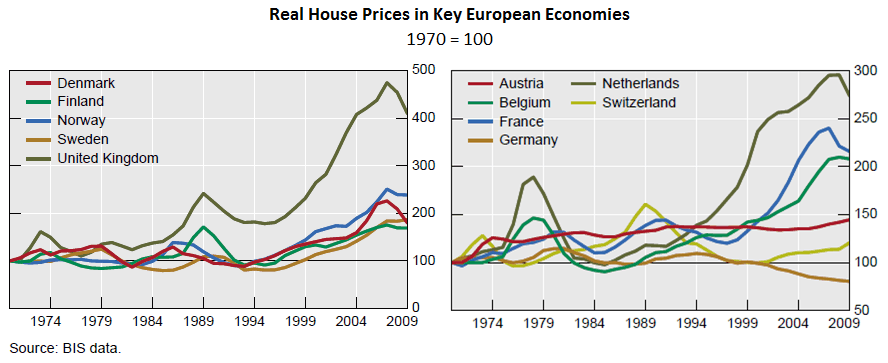
This just doesn't sound right to me, but I haven't gone through the report in detail. Evidently, the differences are driven primarily by real estate wealth. Thankfully (?), Germany escaped the housing price "bubble" that afflicted many European countries; see figure below.


Moreover, as I noted here, the German growth experience over the past 20 years has been nothing to write home about.

Germany: low growth, no asset price bubbles, low wealth, but...stable. Das ist gut?


April 16, 2013: Update here from VOX, who emphasize that the wealth distribution in Germany distorts the picture presented here. 

Røeggendommen gir bare begrenset effekt

DNB er dømt for å gi feil informasjon, ikke for å markedsføre et dårlig produkt. Konsekvensene for de andre investorene kan derfor være begrenset.

Høyesterett opprettholder sitt syn fra Lognvikdommen og velger å ikke å se på differansen mellom lånerente og innskuddsrente som en kostnad. Dette er et litt merkelig syn, da lånet ble gitt spesifikt for å settes tilbake i DNB til betydelig lavere rente. Lånet ble sågar gitt med sikkerhet i produktet.

Høyesterett har kjøpt DNBs forklaring om at siden opsjonen ikke var markedsført til privatpersoner, så var det heller ikke mulig å selge den direkte. Dersom det lot seg gjøre å pakke inn en slik opsjon i et strukturert produkt skulle det vel uansett la seg gjøre å selge den direkte?

En mer troverdig forklaring er vel at ingen markedsførte slike opsjoner fordi den reelle risikoen da ble veldig tydelig. Rene opsjoner var rett og slett usalgbare og måtte pakkes inn i strukturerte produkter slik at informasjon kunne skjules og opsjonene selges.

Problemet med dette produktet var altså mer grunnleggende enn en informasjonsmangel. Lånekostnadene dynget ned produktet slik at det aldri kunne bli lønnsomt sammenlignet med andre alternativer. Det var altså ikke et sjansespill som gikk feil slik Høyesterett har oppfattet, men et produkt som uansett utvikling ville gi betydelig dårligere avkastning enn hvilket som helst relevant alternativ.

Høyesterett har helt rett i at det som er avgjørende er for dårlig informasjon til kunden. Feilinformasjonen var imidlertid langt mer omfattende enn det som kommer frem i dommen. Problemet var ikke bare rene faktafeil i informasjonsmaterialet, men at de reelle kostnadene var skjult.

Hadde banken opptrådt redelig hadde de gitt omtrent samme rente til Røeggen på innskuddsdelen av spareproduktet som det de tok i lånerente. I alle fall burde de oppgitt hele den enorme rentedifferansen. At banken ikke gjordet dette er den største informasjonsmessige forseelsen. Med slik informasjon tilgjengelig ville produkter sannsynligvis vært usalgbart med lånefinansiering.

Germany: The Price of Stability?

My colleague, Fernando Martin, has an interesting chart that plots the real per capita GDP of five industrialized countries since 1991:

 
The data above are expressed as percentage deviations from the U.S. level in 1991, with the initial position calculated using PPP converted GDP per capita from the Penn World Tables. Thus, in 1991, the U.K. is estimated to have had a real per capita income that was 30% lower than the U.S. Germany's real per capita income was only 10% lower than the U.S. in 1991, and so on.

Each of these countries experienced a similar decline in output during the most recent recession. But only Germany has the recession been "temporary." That is, only in Germany has real per capita income returned to its pre-recession trend. The other four countries exhibit persistent "output gaps"--their real per capita income remains below their respective pre-recession trends. Ah, Germany. All hail that Teutonic economic juggernaut.

But just hold on a second. While it is true that Germany appears to have weathered the economic storm better than others, it seems to have done so at considerable cost.

From 1991-2007, German real per capita income grew at a paltry 1.3% per annum. Compare this to the U.S. (2.1%), Canada (2.2%), France (1.6%), and the U.K. (2.9%). These are huge differences in long-run growth rates. In particular, while German income was only 10% below that of the U.S. in 1991, it is presently about 18% below U.S. income. That's called falling behind (albeit, at a steady pace).

And yes, the U.K. presently looks ugly. But it looks considerably less ugly when we take into account the growth record. In 1991, real per capita income in the U.K. was 20% below that of Germany. Just prior to the recession, the U.K. had just about closed that gap. Of course, things have not looked good for the U.K. snce then.

Fernando and I are also led to speculate on the role played by monetary policy for shaping the economic recoveries of these nations. France and Germany, as members of the EMU, operated under the same monetary policy--and yet, their recovery dynamics look very different. Also, since inflation was pretty low over this sample period, real and nominal GDP look practically the same. So for the NGDP targeters out there: it appears that German NGDP is back on target, but not French NGDP. Care to comment?

Moreover, out of this set of countries, only the U.K. has experienced a significant rise in inflation (and hence, NGDP). It's not exactly clear from this data how this "looser" monetary policy has contributed to a more rapid recovery dynamic (although, as usual, we have to be careful because many other things are happening, especially on the fiscal front).
 

Fed Balance Sheet Risks

The Balance Sheet

As everyone knows, the Fed's balance sheet has more than tripled since the financial crisis. Here is a look at the liability side of the Fed's balance sheet:


What's interesting here is that prior to the crisis, almost all the Fed's liabilities were in the form of (zero-interest) cash -- that is, currency in circulation (the blue area). No one knows for sure, but probably over half of this cash is circulating outside the U.S.

At the time of the financial crisis, the balance sheet doubled over a very short period of time, and has continued to grow since then. What's interesting here is that subsequent to the crisis, most of the growing liabilities are in the form of interest-bearing reserves (held by depository institutions with accounts at the Fed).

Now, three trillion dollars sounds like a heck of a lot of liabilities. There is no danger of bankruptcy, however. That's because Fed liabilities are not debt; or, if they are (as in the case of reserves), they are made redeemable in cash, which the Fed can print at any time. Fed liabilities are more like equity shares, than debt. That is, there is a risk of dilution (inflation), but no risk of bankruptcy.

Next question: what did the Fed do with all this money it "printed" up (out of thin air, I might add)? Many people are likely to conjure up an image of "Helicopter Ben."

Alas, that's not quite how it works (even if it does work this way in some other countries, like the recent experience in Zimbabwe). You see, while the Fed is "pumping money into the economy," it is simultaneously sucking some other group of assets out of the economy.

To put things in a slightly different way, the Fed is acting much like, um...well, much like a bank. That is, the Fed finances acquisitions of less liquid assets with more liquid liabilities. The Fed's liquid liabilities look a lot like super short duration Treasuries. What do the assets look like? Take a look here:


Most of the assets consist of interest-bearing securities, primarily U.S. government debt and agency MBS. In 2012, this portfolio yielded over 3%. In 2012, the Fed remitted $89B to the Treasury (historically, remittances have been around $25B per year). Not a bad return, for a year of "helicopter drops."

In the meantime, inflation appears to be fairly well centered around the Fed's 2% inflation target (recent data is coming in below target):


TIPS based measures of inflation expectations appear to be fairly well centered around 2% as well (recent data appears to be rising a bit away from target):


While inflation and inflation expectations appear to be muted for the time-being, a number of economists and Fed officials still worry about the various risks associated with the Fed's large and growing balance sheet. The most obvious worry is the risk of inflation. The extent to which one worries about inflation depends a lot on one's theory of inflation, which I will explain below.

(New) Keynesian View

In the extreme version of this view (Woodford's cashless economy), Fed liabilities serve only as a unit of account; and the private sector manufactures the "money" it needs. The Fed determines (influences) the nominal interest rate, which influences the aggregate demand (AD) for goods and services. Inflation is determined in part by the pricing decisions of firms. When AD is strong, prices rise more rapidly; and conversely when AD is weak. Inflation is also determined in part by the Fed's policy function (Taylor rule), which stipulates a long-term inflation target (serving as the nominal anchor) together with the promise to alter the interest rate (hence AD) in response to undesirable movements in inflation away from target.

Conspicuously absent from the theory of inflation above is any role played by the money supply. The Fed's balance sheet plays no role in determining inflation according to this view. It follows as a corollary that the size of the Fed's balance sheet poses no economic risk.

This world view likely explains the statements made by the more dovish members of the FOMC. Inflation is low because aggregate demand is weak. We need to keep interest rates low. Additional QE by the Fed is mostly innocuous--except possibly for political reasons.  What do I mean by this? Let me explain.

Federal Reserve Board economist Seth Carpenter (and his coauthors) have recently distributed an interesting working paper that offers a methodology for making projections about the way the Fed's balance sheet is to evolve over time, see: The Federal Reserve's Balance Sheet: A Primer and Projections. In some of their projections, the Fed actually incurs an operating loss and remittances to the U.S. Treasury cease for a while. The economic consequences of this are innocuous if you're coming at things from a strict New Keynesian perspective. But the optics can be made to look bad, something that politicians hostile to the Fed are likely to exploit. Let me consider a simple example.

The Fed currently pays 1/4% on excess reserves, which are presently close to $2T. In one year's time, and under currently policy, reserves will be closer to $3T. The annual interest expense associated with these reserve liabilities is presented in the following table, for various interest rates (IOR):


Now, perhaps this is unlikely, but it is certainly not outside the realm of possibility: Imagine that inflation and inflation expectations begin to rise sharply at the end of 2013. The Fed's policy response is to jack up it's policy rate (IOR) sharply, say, to 3%.  If reserves remain close to $3T, that's about $90B in interest payments to banks and hence, $90B less in remittances to the Treasury.

From an economic (a consolidated Fed and Treasury balance sheet) perspective, interest-bearing reserves look a lot like interest-bearing Treasuries. So whether the Fed or the Treasury services this debt makes little difference to the American taxpayer. Naturally, this is not the way things will be portrayed in the political arena.

(New) Monetarist View

According to this view, there are financial market imperfections (limited commitment, asymmetric information, etc.) that allow Fed and Treasury liabilities to be valued for their liquidity/collateral properties. Inflation, in the long-run at least, is determined by the supply and demand for currency (a special type of Fed liability).

In normal times, currency is dominated in rate of return, so their is a well-defined demand for the stuff. As well, in normal times, reserves are dominated in rate of return, so Fed liabilities are mostly in the form of currency (see first diagram above, prior to 2008). A well-defined demand for currency plus Fed control over the supply of currency means that the Fed can control inflation.

In abnormal times, however, reserves and Treasuries earn (roughly) the same rate of return. In this case, the Fed only controls the total supply of its liabilities--the composition of these liabilities between currency and reserves is determined by banks. Reserves are like a demand deposit liability--convertible into currency on demand. The Fed can influence bank redemption policies by manipulating IOER--if it has this tool available. Note that the Fed has only had this tool available since 2008. (And in light of the political risks outlined above, one could easily imagine Congress taking this tool away.)

If inflation and inflation expectations begin to rise, so should the nominal demand for currency (even if the real demand remains more or less fixed). One might expect a flood of currency into the economy as banks exercise their redemption option on reserves. The flood of currency could potentially validate the higher inflation expectations -- a self-fulfilling prophesy.

[Note: I have refined this idea in this post here: Excess Reserves and Inflation Risk (June 22, 2014) ]

In many of our models, we assume passive support from the Treasury to support whatever needs to be done to keep inflation in check. But how realistic is this? What if that support does not materialize? And moreover, suppose that the Fed is no longer permitted to use IOR as a policy tool? What if inflation and inflation expectations start to rise? What then?

In this case, the only way the Fed can "suck out" excess liquidity is via asset sales. In a sense, the value of the Fed's assets represents the extent to which the Fed can credibly commit to withdraw cash from circulation (the Fed has no ability to tax). But if inflation expectations rise, so will longer term interest rates. The Fed's assets will decline in value. And with the decline in value, the ability to purchase cash.

What sort of capital losses are we talking here? Obviously, it depends. The average maturity of the Fed's asset portfolio is around 10 years (up significantly from historical norms, thanks to Operation Twist, etc.). The following formula provides a rough approximation of exposure to interest rate risk:

1 ppt increase in the interest rate = (average duration)% decline in bond price

So, to take a bad (but not worse case) scenario, suppose interest rates rise by 5 ppt (e.g., China decides to unload its holdings of U.S. Treasuries?). We are talking about a 50% (somewhat less) loss on the Fed's $3T portfolio. The remaining $1.5T in asset value would not be enough to suck out the current $2T in reserves. There would be $0.5T in reserves remaining--representing $0.5T in potential new currency (a 50% increase over the current supply of $1T).

Conclusions

No one knows for sure which of the two theories of inflation above is the better approximation for our current reality. Central bankers are charged with the task of evaluating the risk of their policies under different theoretical scenarios. If the monetarist view is correct, then continued expansion of the Fed's balance sheet exposes the economy to ever higher inflation risk. Of course, this is not to say that the risk is not worth taking. Policymakers just need to be aware of the risk and make provisions for it.

It is interesting to note, however, that independent of one's theory of inflation, the large and growing balance sheet may expose the Fed to a certain type of political risk. If tightening needs to happen in the future, the Fed will have to raise interest rates (IOR) and/or sell off its assets. IOR may be made to look like Fed Reserve (instead of Treasury) transfers to the banking sector, at taxpayer expense. Capital losses on asset sales would similarly reduce remittances to the Treasury. It's not going to look very pretty.

Hvem har ansvar når ingen eier ...

Interessant inlegg i Finansavisen i går i debatten om hvem som eier aksjeselskaper.

Noe som kanskje er mer interessant enn å diskutere hva ordet eierskap betyr nøyaktig, er imidlertid hva professor Sjåfjell mener bør være de reelle konsekvensene av at aksjonærene ikke eier selskapet: “Styret har etter loven ansvaret for å balansere de forskjellige interesser knyttet til selskapet og ivareta den langsiktige selskapsinteressen”.

Men hvilken interesse har styret i å drifte selskapet hensiktsmessig dersom ingen eier det? Det er naturligvis helt riktig at et selskap kan prioritere annerledes enn å levere verdi til aksjonærene. Selskapet kan for eksempel prioritere å gi ansatte høyere lønn enn strengt tatt nødvendig, eller det kan prioritere ledelsen og styrets behov. Et selskap som styrer etter sistnevnte prinsipp kalles for et administrasjonsstyrt selskap.

Dette begrepet er for de fleste å regne som et skjellsord. Administrasjonsstyrte selskap er utmerket for administrasjonen, men ikke for så mange andre. I Norge finner vi særlig mange administrasjonstyrte selskaper innen kraftbransjen, der mange selskaper er eid av kommuner uten kompetanse på eierskap.

Resultatet er nedslående. Ulike kraftselskaper har ødelagt milliarder for kommunale aksjonærer på dyre oppkjøp og håpløse prosjekter, ofte med liten eller ingen tilknytning til kjernevirksomheten. Jeg vet ikke om dette egentlig er noe å strekke seg etter.

Sjåfjell fortsetter sitatet over med at styret har ansvar for å balansere de ulike interessene “…, inkludert men ikke begrenset til aksjonærenes interesse i å få profitt på sin aksjeinvestering.” Det spørs midlertid om det tross alt ikke er bedre at det endelige ansvaret for selskapet plasseres hos dem som må ta sluttregningen. Det er ikke umulig at det faktisk gir den beste langsiktige styringen. Enkle skjeler vil kanskje kalle slikt ansvar for eierskap.