A Quick Argument Why Not to Raise Interest Rates

I teach today, so this will be quick. Why am I opposed to raising interest rates?

First, I should mention this is a debate which we've had before. When the Fed decided to leave it's balance sheet unchanged for all of 2009 and 2010 -- while the economy burned -- I thought it was a mistake. When Ben Bernanke raised the discount rate in 2010, I wondered if he had lost his marbles. The result was a 63 seat loss in the House for the Dems and a full decade of Tea-Baggers in the Congress (and maybe more, depending to what extent gerrymandering affects local House elections which will then affect the next redistricting). Given that the economy continued to grow slowly after that, I think I was justified.

Next, after QE2 at the end of 2010, I believed the Fed should have acted sooner than the end of 2012 for QE3, given the fact that growth was slower than it anticipated.

Then, I thought 2014 was too soon to taper, given that inflation was below target and GDP growth was below trend.

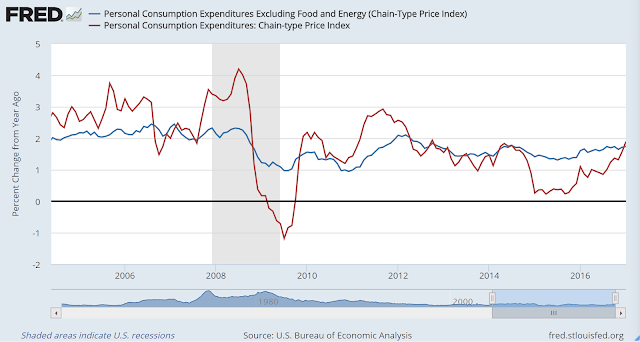
At the end of 2015, I also, not suprisingly, thought it was too soon to tighten. Once again, 2016 was a year of slow GDP growth and below-target inflation. So, in retrospect, I think that was the right call. The last two rate hikes, I believe, are also premature. Unemployment is now super low, and employment gains the past several months indeed look solid. Thus it isn't crazy to hike now. But the unemployment rate and current headline inflation rates are not the only numbers the Fed should be looking at. The Core PCE is still pretty stable, below 1.8% for the last reading, and while headline inflation is now close to 2% and will soon likely move higher if current trends continue, this measure was also close to zero as recently as 2015, a year in which the Fed actually raised interest rates. The Fed shouldn't ignore that inflation has been below it's target for most of the period since 2008, that the employment-to-population ratio for prime-aged workers, while trending in the right direction, still has a lot of room to recover, and that RGDP is some 20-25% below it's long-run trend. Given that inflation has been below target for so long, why not let inflation run above target for awhile to allow GDP to catch up with its previous trend?

And, add to this that our inflation target is too low. Clearly, the Fed has trouble managing the economy at the zero lower bound. A 2% inflation target means that any large shock will push us into a liquidity trap. This seems more-or-less obvious. Why not raise the target to 3%?

The only silver lining here for Democrats is that this hurts Trump and Republicans. But they've been pushing the Fed for tighter policy for years. One wonders if they will soon start to change their tune.


A Policy Proposal for US Manufacturing, and the Economy: Don't Raise the Federal Funds Rate

Doug Irwin shared a nice article in the WSJ which makes a nice point that trade deficits, by themselves, don't imply that trade is unfair. It's a good article. Here is one part: 

The Trump team is correct in believing that sometimes trade imbalances reflect government tampering, though in the capital markets. Messrs. Gagnon and Bergsten found that countries who buy foreign currency to suppress the value of their own tend to have larger trade surpluses. 
In the past Chinese currency intervention and tight controls on capital inflows kept the yuan artificially cheap and its trade surpluses inflated. Brad Setser of the Council on Foreign Relations says Taiwan and South Korea have held down their currencies via currency intervention and by encouraging domestic investors to buy foreign assets and discouraging foreign investors from buying domestic assets.
These actions are legitimate cause for complaint. Yet finding an effective deterrent has eluded previous presidents and it’s not clear what Mr. Trump can do differently. Punishing China for manipulating its currency makes less sense now that China is trying to prop it up, rather than push it down as in the past.
Let me offer a solution, that happens to cure other, perhaps more serious problems with the economy. The Fed should simply not raise interest rates as it is doing. In fact, it should probably be cutting them. If it did, the dollar will fall, and this will help manufacturing and help the trade balance. It would help the US move back toward its long-run growth path, and help inflation move up to its ostensible target. Unemployment is now low, and while it isn't crazy to think the Fed should raise interest rates, the Fed should transition to a 3% (or 4%) inflation target to make future zero lower bound episodes more unlikely, and they should treat that target symmetrically. This is a simple pro-trade and pro-manufacturing policy that will anger almost no one and actually be good for the rest of the world economy, as it will spur faster growth. Manufacturing employment will grow on two counts -- one from faster growth, and a second from a weaker dollar. This is the obvious play to help manufacturing, and what I pushed for when I worked in the Obama administration.

The Peso has recovered. Good news for the future of NAFTA...

With the US dollar already a bit overvalued, and the US stock market also looking richly valued by historical measures, I need something to invest in each month. Thus, I decided to have a look at LT government bonds in Mexico, and the value of the peso, to play the carry trade/uncovered interest parity puzzle. Last I'd checked, the Peso had depreciated a lot from its pre-election levels. Turns out, not any more. The peso is roughly back to pre-election levels. Looks like the conventional wisdom now is that nothing really will happen to NAFTA. 


This is great. Ending NAFTA was a horrible idea, and Mexico has, at most, only a little to do with the decline of American manufacturing. It's also possible that trade with Mexico has helped soften the blow to American manufacturing, as cheap Mexican labor can sometimes be a complement in production for some sectors. This may be why most of the countries near to China, with the exception of Japan, are not now in depressions. (In fact, someone needs to write a paper about this...) Below is the NAFTA trade balance ex-oil. You'll notice it's always been roughly balanced. Ending NAFTA would create winners and losers in the US, but you can bet the losers (at least the exporters, not the consumers) would scream louder than the winners would applaud. 


The Real Exchange Rate and China's Savings

I attended the Forum for Research in Empirical International Trade (FREIT) in Yogyakarta, Indonesia this past week. Marc Muendler and I were debating the source of China's excess savings, over and above its high level of investment. China's high savings rate could have multiple causes (e.g., lack of a social safety net implies a need for precautionary savings, while countries that are growing fast, such as the Asian Tigers, have a clear tendency to save a lot), and various policies could be at play. However, in this post I merely want to lay out how an undervalued real exchange rate, which can be accomplished with a combination of capital controls and foreign reserve accumulation, could increase the rate of savings.

The short story is that an undervalued RER will increase exports and decrease imports, and this equals the gap between savings and investment by accounting identity.

First, why does a high savings rate matter? A high savings rate (over investment) means that China will be exporting both capital and goods to the US, and that it won't be importing many goods. This is due to accounting identity: Savings (S) - Investment (I) = Exports (X) - Imports (M).

Imagine that, at first, S = I, which implies that X = M, while the RER is fairly valued. Now imagine that China devalues its RER by 40%. This change in relative prices means that exports will surge while imports will fall. This will also imply that savings will be less than investment. What is the logic? Let's have a closer look at accounting identities:

Y = C + I + G + X - M

(Where Y = output, C = consumption, I = Investment, G = Government spending, etc.)

Clearly, if the Yuan is weak, then, on one hand, China will export more, and on the other, it will import less. Thus, output will rise. That's straightforward. Total consumption (of domestically produced goods and of imports) may decrease by a little as imports become more expensive, but this effect is likely to be drowned out by changes in the trade balance. It could decrease by more if China also raises domestic interest rates to counter inflation, something which would cause imports to plunge further. How will savings increase? Savings is income not taxed or spent:

S = (Y - T - C) + (T - G)

Total savings equals private and public savings. Fast Chinese growth will also tend to boost T relative to G, and might also boost Y relative to C. If China undervalues its exchange rate, and also raises its domestic interest rates to contain inflation, C could fall, raising savings. There could also be a cultural explanation as Asian countries tend to have high levels of savings in general, although this doesn't explain why savings is larger than investment, or why savings rates have declined recently in Japan and Taiwan (or why growth pre-dated high savings rates in several of these countries). Trade doesn't show up here, but we can substitute in for Y from the equation above, and get:

S = (( C + I + G + X - M ) - T - C ) + ( T - G )

And now simplify to:

S - I  = X - M

Savings minus investment equals exports minus imports. Exports and imports clearly depend on the real exchange rate, and thus so does the gap of savings over investment. I'm not always the biggest advocate for the use of mathematics in economics, but in some cases it can really help for clarification. The above algebra makes this result seem obvious and intuitive, but your average intelligent guy-in-a-bar wouldn't find a link between the exchange rate and savings intuitive or obvious without looking at the math.

A more controversial assertion is that, because of hysteresis, an undervalued exchange rate yesterday could mean you'll have a larger tradables sector today, and thus more savings. On the other hand, in recent years, with weaker Chinese growth and looser monetary policy, the Chinese government in has been trying to prop up the currency, although this doesn't necessarily mean that the Chinese currency is overvalued from the perspective of its tradable sector. But it does mean that this is a topic deserving of further study.

Robots on an Assembly Line...

Mercedes A Class Production Line

You'll notice, not a lot of human workers. When you see this, you might think -- "Aha! It's not foreigners who have taken our jobs, but robots." However, increases in productivity are not a new development for US manufacturing. In fact, labor productivity growth has been slower than usual for the median manufacturing sector since 2000.

Second point, labor-saving technology is *not* what is wrong with the US economy. Faster productivity growth in production means lower inflation, which means more stimulative US monetary policy (or at least it should). That means more GDP growth and more employment elsewhere.

This, this video doesn't imply that there still isn't *something* wrong with the US manufacturing sector, and that something is not fast productivity growth. Still, somehow it's fascinating to watch an assembly line.

Boligspekulantene er nyttige

Finansdepartementets svar på galopperende boligpriser er å sette hindringer i veien for nye boligprosjekter.

Boligprisene stiger fordi det bygges for få boliger. Dette er finansdepartementet forståelig nok bekymret for. Departementet har derfor funnet ut at det er en god idé å gjøre det enda vanskeligere å bygge boliger.

Rett før jul bestemte regjeringen at det skal kreves minimum førti prosent egenkapital ved kjøp av sekundærbolig, men bare i Oslo. For resten av landet forblir kravet femten prosent. Tiltaket skal ramme kyniske boligspekulanter som driver opp prisene i boligmarkedet.

Problemet er bare at på sikt gir spekulanter lavere og ikke høyere boligpriser. Før et byggeprosjekt kan igangsettes krever banken at de fleste enhetene må være solgt. Desto flere spekulanter, desto enklere er det å forhåndsselge boenheter. Spekulantene bidrar dermed til økt boligbygging. Flere boliger er sannsynligvis det mest effektive bidraget til lavere boligpriser.

Men boligspekulanter er takknemlige syndebukker. De er utspekulerte, kanskje til og med ganske griske, og de svarer ikke tilbake. Siden innstrammingen har det ikke vært et eneste leserbrev i norske aviser undertegnet «boligspekulant».

At myndighetene setter krav til egenkapital generelt er forståelig. Når gjelden blir for høy kan en liten renteendring føre til at boligeierne får problemer med å betjene lånene sine. Som finanskrisen viste kan resultatet bli at bankene går over ende.

Men når tiltakene spesialsys for å ramme boligspekulanter så er myndighetene på ville veier. For det første har slike innstramminger som nevnt helt motsatt effekt på prisene på sikt. For det andre er Finanstilsynets boligprisbesettelse et blindspor. Joda, det er en sammenheng mellom boligpriser og kredittvekst. Men la oss ta et kontrollspørsmål; ville Finanstilsynet vært mer fornøyd om kredittveksten hovedsakelig gikk til forbruksgjeld og ikke boligkjøp? Svaret er nok nei.

Hovedproblemet er altså kredittveksten, ikke boligprisveksten. En generell regel om krav til egenkapital er sannsynligvis et ganske godt tiltak mot kredittvekst. Det vil kanskje også dempe boligprisveksten.

Men når departementet iverksetter tiltak rettet mot boligspekulantene spesielt, så ligner det mer på et moralistisk prosjekt mot bolighaier i Oslo enn et veloverveid tiltak for å begrense kredittveksten.

Hva er nå egentlig de faglige argumentene for at kjøp av sekundærbolig er mer risikabelt enn kjøp av primærbolig? Finnes det data som støtter at eiere av sekundærboliger tåler renteøkning dårligere enn de som bare eier sin primærbolig? Dersom investeringer i sekundærboliger faktisk er mer risikabelt, hvorfor gjelder reglene kun for sekundærboliger i Oslo?

Den vanvittige utviklingen i boligmarkedet de siste årene skyldes en kombinasjon av lave renter og boligunderskudd. Det er ingen god grunn til å tro at problemene først og fremst skyldes spekulanter. Figuren viser at om osloborgerne skulle bodd like romslig som i år 2000, måtte vi satt rundt 80 000 av dem på gata. Boligunderskuddet er løst ved at antall personer per bolig har økt fra 1,8 til 2. Noe av dette kan nok tilskrives at innvandrere bor tettere, men det viser også at det bygges for få boliger. Oslo kan ikke fortsette å løse boligproblemene ved å presse flere personer inn i hver bolig. Å lage spesialordninger for Oslo som hindrer finansiering av flere boliger virker derfor lite hensiktsmessig.

Saken har selvsagt vært ute på høring. I flere høringssvar ble det argumentert med at innstrammingen ville ramme finansieringen av nye boligprosjekter. Departementet valgte å ignorere advarslene.


Antall person uten bolig dersom osloborgerne skulle bodd like romslig som i 2000.
Figuren viser akkumulert differanse mellom befolkningsøkningen og veksten i husrom i Oslo kommune dersom antall personer per bolig skulle holdt seg konstant på 2000-nivå (1,8 personer per bolig). Kilde: SSB.